Normal Distribution Calculator, Formula and Examples
Use this online normal distribution calculator to calculate the probability area of a standard normal variate (Gaussian distribution). It computes probabilities like P(X < x) or P(x1 < X < x2) with step-by-step calculations.
Gaussian Distribution and Formula
Normal Distribution is also well known by Gaussian distribution. It's a continuous probability density function used to find the probability of area of standard normal variate X such as P(X < X1), P(X > X1), P(X < X2), P(X > X2) or P(X1 < X < X2) in left, right or two tailed normal distributions. The data around the mean generally looks similar to the bell shaped curve having left and right asymptote tails both extends to infinity. Generally, 68.27%, 95.45% and 99.73% data observations fall around the mean between ±1σ, ±2σ and ±3σ respectively. The range of data or standard normal variate x lies anywhere between -∞ and +∞. μ - σ and μ + σ represents the left and/or right side attributes of distribution. A smaller and larger standard deviation values represent how the data is tightly or loosely bundled around the mean accordingly. The negative and positive values of Z-score lies on the left and right side of the mean of standard normal distribution respectively. The negative z-score lies on left side represents the left tail and the positive score lies on right side represents right tail of the normal or Z-distribution. By using this normal distribution table and calculator, user may estimate what is the probability of standard normal variate range in left, right or two tailed normal distributions.
The below formula is the mathematical representation of Gaussian distribution to know what are all the input parameters are being used to find the probability of area of data range in left, right or two tailed normal distributions. Users may use this formula to find the probability of x-variate range, use the calculator to verify the results or generate the complete work with steps for normal distribution worksheet problems.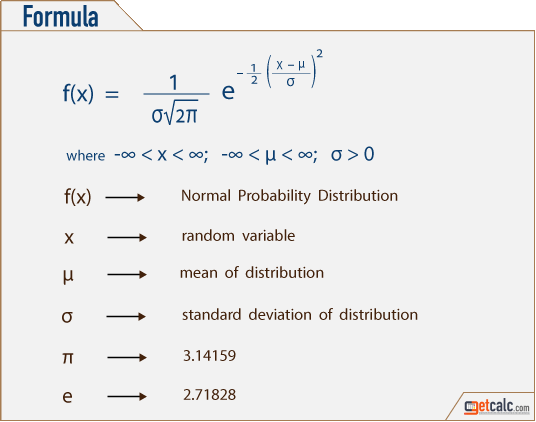
Solved Example Problems with Solutions
Users may refer the below solved example problems with step by step solutions to learn how the input parameters are being used in the above formula to find the probability of range of standard normal variate in left, right or two tailed normal distribution. By using this calculator or formula, user may find what is P(X < X1), P(X > X1), P(X < X2), P(X > X2) or P(X1 < X < X2) in statistical experiments.