F-Test (F0, Fe and H0) Calculator
Use this online F-test calculator to estimate the F-statistic (F0), critical value (Fe) from the F-distribution, and perform hypothesis testing (H0) comparing two sample variances. It provides a complete step-by-step mathematical workout to evaluate statistical significance.
Why F-Test and Formula
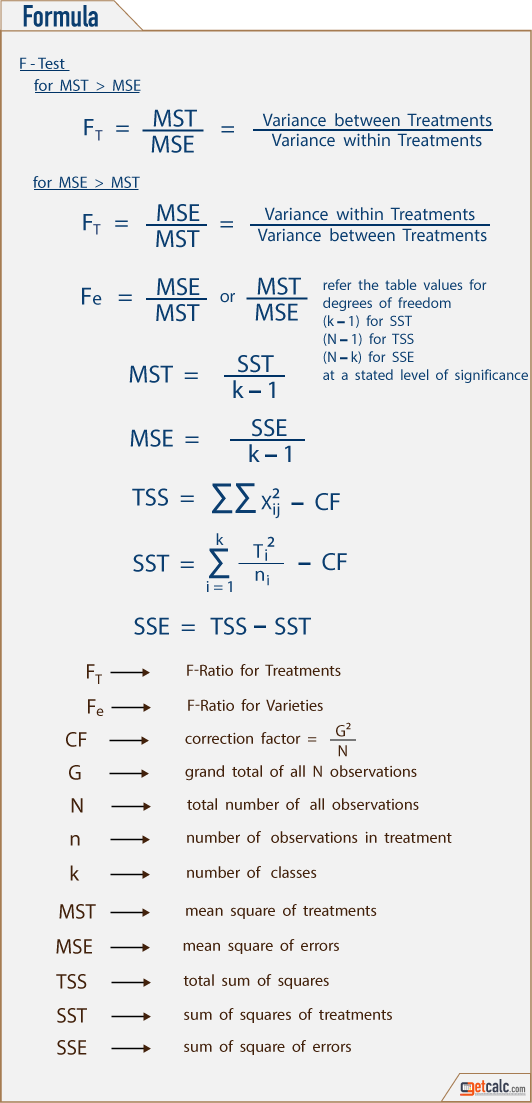
F-Test is the technique using statistical methods to estimate if the test results are statistically significant by analyzing two or more variances. It requires F-statistic F0 and critical (table) value of F-distribution Fe at a stated level of significance (α = 1%, 2%, 3%, 4%, 5%, 10%, 25%, 5% etc or α = 0.01, 0.02, 0.03, 0.04, 0.05, 0.1, 0.25, 0.5 etc) for the test of hypothesis (H0) in statistics and probability surveys or experiments to analyze two or more variances simultaneously. Generally, F-test is the ratio between two or more variances to identify the quality of different variances. The estimated value of F or F-statistic (F0) is compared with the critical value from F-distribution table to check the significance of results. Users may use this below F-test calculator to estimate F-statistic (F0), critical value (Fe) and hypothesis test (H0) to test the significance between two or more sample variances.
Inference
The below statements show when to accept or reject null hypothesis H0 in F-test
For null hypothesis H0 :
If F0 < Fe then the null hypothesis H0 is accepted.
It states that there is no significance difference between F-statistic and expected or critical value of F.
If F0 > Fe then the null hypothesis H0 is rejected.
It states that there is significance difference between F-statistic and expected or critical value of F.
The below is the mathematical representation for F-test formula to estimate the quality of variances among two or more sample variances to predict the characteristics of population parameters of a unknown distribution.
Solved Examples with Work - F-Test
The below are the solved examples for F-Test with step by step estimation to analyze two or more variances together. Users may refer the below estimations to know what formula and input parameters are being used in the respective calculation.