Unlike and Improper Fractions Average Calculator
This free online unlike and improper fractions average calculator is a basic math tool to find the average of two or more proper, improper, like, unlike, negative, and positive fractions including mixed numbers. It displays a step-by-step workout for every calculation to help you understand how to sum the values and divide by the total count. You can input mixed numbers directly in the format of A(B/C) [e.g., 2(1/2) for 2 1/2] without converting them first.
Multiple Fractions Average and Formula
The average of multiple fractions (also known as the arithmetic mean of fractions) is calculated by finding the sum of all fractions in the dataset and then dividing that sum by the total count of numbers. Any whole numbers or integers are treated as fractions with a denominator of 1. Below is the mathematical representation for finding the average of multiple fractions:
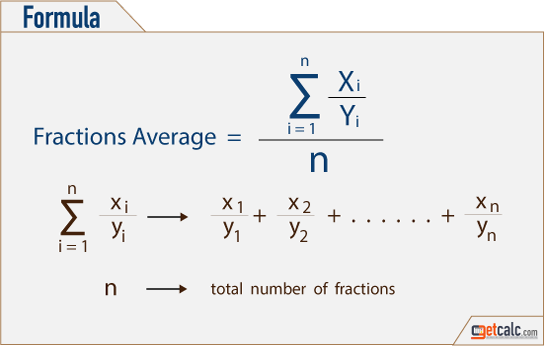
Find the Average of Multiple Unlike Fractions and Mixed Numbers
Finding the average (arithmetic mean) of multiple fractions requires summing all the fractions together and then dividing that sum by the total count of fractions. Whole numbers are converted to fractions by placing them over 1, and mixed numbers are converted to improper fractions first. The addition step involves finding a common denominator (using the least common multiple), and the final result is divided by the total number count. You can use the step-by-step solved examples below to learn how to find the average of multiple unlike fractions, mixed numbers, and integers.
- How to find the average of two, three, or more fractions?
- How to calculate the average of multiple fractions and whole numbers?
- How to find the average of mixed numbers and unlike fractions?
Average of Three Unlike Fractions
The solved example below shows the step-by-step workout for finding the average of three unlike fractions (fractions with different denominators). You can use our unlike fractions average calculator to find the average of any number of like, unlike and improper fractions to generate the step by step workout like the one below.
ProblemFind the average of fractions 1/2, 1/3 and 1/4.
Step by step workout
step 1 Address formula and input values.
Input values:
1/2, 1/3 , 1/4
Total count = 3
(1/2 + 1/3 + 1/4)/3 = ?
step 2 To find the sum for fractions with different denominators, find the LCM (least common multiple) for all denominators. 12 is the LCM for 2, 3 and 4.
step 3 Multiply LCM 12 with each numerators and denominators
= (1 x 12)/(2 x 12) + (1 x 12)/(3 x 12) + (1 x 12)/(4 x 12)
step 4 Simplify the above expression to bring same denominators for all fractions.
= 6/12 +4/12+3/12
= (6 + 4 + 3)/12
step 5 Add all numerators and rewrite it in a single form.
= 13/12
1/2+1/3+1/4= 13/12
step 6 Divide the sum by total count of fractions.
(1/2 + 1/3 + 1/4)/3 = (13/12)/3
13/12is the average of three fractions 1/2, 1/3 and 1/4.
Average of Three Like Fractions
The solved example below shows the step-by-step workout for finding the average of three like fractions (fractions with equal denominators). You can use this unlike fractions average calculator to find the average of any number of like, unlike, and improper fractions.
ProblemFind the average of fractions 5/9, 6/9 and 7/9.
Step by step workout
step 1 Address formula and input values.
Input values:
5/9,6/9,7/9
Total count = 3
(5/9 + 6/9 + 7/9)/3 = ?
step 2 Find the sum of all fractions.
(5 + 6 + 7)/9=18/9
=18/9
step 3 Divide the sum by total count of fractions and simplify
= (18/9)/3
(5/9 + 6/9 + 7/9)/3 = 2/3 in fraction form
(5/9 + 6/9 + 7/9)/3 = 0.66 in decimal form
2/3 or 0.66 is the average of three fractions 5/9, 6/9 and 7/9.
Average of Multiple Unlike Fractions and Whole Numbers
The solved example below shows the step-by-step workout for finding the average of multiple unlike fractions with whole numbers. You can use this unlike fractions average calculator to find the average of any number of like, unlike, improper fractions and whole numbers to generate the step by step workout like the below.
ProblemFind the average of fractions and whole numbers 2/3, 3/4, 6, 4/5, 3, 5/6 and 8/9.
Step by step workout
step 1 Address formula and input values.
Input values:
2/3,3/4,6,4/5, 3 ,5/6,8/9
Total count = 7
2/3,3/4,6,4/5, 3 ,5/6,8/9 = ?
step 2 Convert whole numbers to fractions and rewrite as below
Any whole number or integer is a rational number (quotient of 1), hence the denominators for all whole numbers is 1 and can be written as
6 =6/1
3 =3/1
step 3 Arrange all the numbers as fractions
2/3+3/4+6/1+4/5+ 3/1+5/6+ 8/9
step 4 To find the sum for fractions with different denominators, find the LCM (least common multiple) for all denominators. 180 is the LCM for 3, 4, 1, 5, 1, 6 and 9.
step 5 multiply LCM 180 with each numerators and denominators
=(2 x 180)/(3 x 180)+(3 x 180)/(4 x 180) +(6 x 180)/(1 x 180)+ (4 x 180)/(5 x 180)+(3 x 180)/(1 x 180)+(5 x 180)/(6 x 180)+(8 x 180)/(9 x 180)
step 6 simplify the above expression to bring same denominators for all fractions.
=120/180+135/180+1080/180+144/180+540/180+150/180+160/180
=(120 + 135 + 1080 + 144 + 540 + 150 + 160)/180
step 7 add all numerators and rewrite it in a single form.
=2329/180
=2/3+3/4+6/1+4/5+ 3/1+5/6+ 8/9=2329/180
step 8 Divide the sum by total count of fractions.
(2/3 + 3/4 + 6/1 + 4/5 + 3/1 + 5/6 + 8/9)/7 = (2329/180)/7
= 2329/1260
2329/1260 is the average of fractions and whole numbers 2/3, 3/4, 6, 4/5, 3, 5/6 and 8/9.
Average of Multiple Positive and Negative Unlike Fractions
The solved example below shows the step-by-step workout for finding the average of multiple positive and negative unlike fractions. You can use this unlike fractions average calculator to find the average of any number of like and unlike positive and negative fractions to generate the step by step workout below.
ProblemFind the average of multiple whole numbers, positive and negative fractions 2/3, 2/4, -2/5, 6, 2/7, -3/9 and 2/9.
Step by step workout
step 1 Address formula and input values.
Input values:
2/3,2/4,-2/5, 6 ,2/7,-3/9
Total count = 6
(2/3 + 2/4 + -2/5 + 6 + 2/7 + -3/9)/6 = ?
step 2 Convert the whole numbers to fractions, if any
6 = 6/1
step 3 Arrange all the numbers as fractions.
2/3+2/4+-2/5+6/1+2/7+-3/9
step 4 To find the sum for fractions with different denominators, find the LCM (least common multiple) for all denominators. 1260 is the LCM for 3, 4, 5, 1, 7 and 9.
step 5 Multiply LCM 1260 with each numerators and denominators
=(2 x 1260)/(3 x 1260)+(2 x 1260)/(4 x 1260)-(2 x 1260)/(5 x 1260)+(6 x 1260)/(1 x 1260)+(2 x 1260)/(7 x 1260)-(3 x 1260)/(9 x 1260)
step 6 Simplify the above expression to bring same denominators for all fractions.
=(2 x 420)/(1260)+(2 x 315)/(1260)-(2 x 252)/(1260)+(6 x 1260)/(1260)+(2 x 180)/(1260)-(3 x 150)/(1260)
=840/1260+ 630/1260- 504/1260 + 7560/1260 + 360/1260 - 450/1260
step 7add all numerators and rewrite it in a single form.
=(840 + 630 + 504 + 7560 + 360 + 450)/1260
=10344/1260
=862/105
(2/3 + 2/4 + -2/5 + 6 + 2/7 + -3/9) = 862/105
step 8 Divide the sum by total count of fractions.
(2/3 + 3/4 + 6/1 + 4/5 + 3/1 + 5/6 + 8/9)/6 = (862/105)/6
= (431/105)/3
=431/315
431/315 is the average of multiple whole numbers, positive and negative fractions 2/3, 2/4, -2/5, 6, 2/7, -3/9 and 2/9.
Mixed Numbers and Unlike Fractions Average
The solved example below shows how to find the average of a set of mixed numbers, integers, and unlike fractions using the step-by-step common denominator method. You can use this unlike fractions average calculator to find the average of any number of mixed numbers, whole numbers and proper fractions.
ProblemFind the average between multiple fractions, mixed and whole numbers 2/3, 4/5, 6/7, 3(8/9), 6(1/2) and 9.
Step by step workout
step 1 Address formula and input values.
Input values:
2/3,4/5,6/7, 3 8/9, 6 1/2, 9
Total count = 6
(2/3 + 4/5 + 6/7 + 3(8/9) + 6(1/2) + 9)/6 = ?
step 2 Convert the whole numbers to fractions, if any
9 = 9/1
step 3 Convert the mixed fractions to fractions, if any
38/9= ((3 x 9) + 8)/9= 35/9
61/2= ((6 x 2) + 1)/2= 13/2
step 4 Arrange all the numbers as fractions.
2/3+4/5+6/7+35/9+13/2+9/1
step 5 To find the sum for fractions with different denominators, find the LCM (least common multiple) for all denominators. 630 is the LCM for 3, 5, 7, 9, 2 and 1.
step 6 Multiply LCM 630 with each numerators and denominators
=(2 x 630)/(3 x 630)+(4 x 630)/(5 x 630)+(6 x 630)/(7 x 630)+(35 x 630)/(9 x 630)+(13 x 630)/(2 x 630)+(9 x 630)/(1 x 630)
step 7 Simplify the above expression to bring same denominators for all fractions.
=(2 x 210)/(630)+(4 x 126)/(630)+(6 x 90)/(630)+(35 x 70)/(630)+(13 x 315)/(630)+(9 x 630)/(630)
=420/630+504/630+54/630+2450/630+4095/630+5670/630
step 8 Add all numerators and rewrite it in a single form.
=(420 + 504 + 54 + 2450 + 4095 + 5670)/630
=13193/630
(2/3 + 4/5 + 6/7 + 3(8/9) + 6(1/2) + 9) = 13193/630
step 9 Divide the sum by total count of fractions.
(2/3 + 4/5 + 6/7 + 3(8/9) + 6(1/2) + 9)/6 = (13193/630)/6
=13193/3780
13193/3780 is the average of multiple fractions, mixed and whole numbers 2/3, 4/5, 6/7, 3(8/9), 6(1/2) and 9. Whether you are working with proper, improper, like, or unlike fractions, mixed numbers, or integers, this mixed numbers average calculator, unlike fractions average calculator, and improper fractions average calculator is designed to make finding the average simple and efficient. Enter your math problems in the input field above to instantly compute the simplified average and view detailed step-by-step calculations today!